


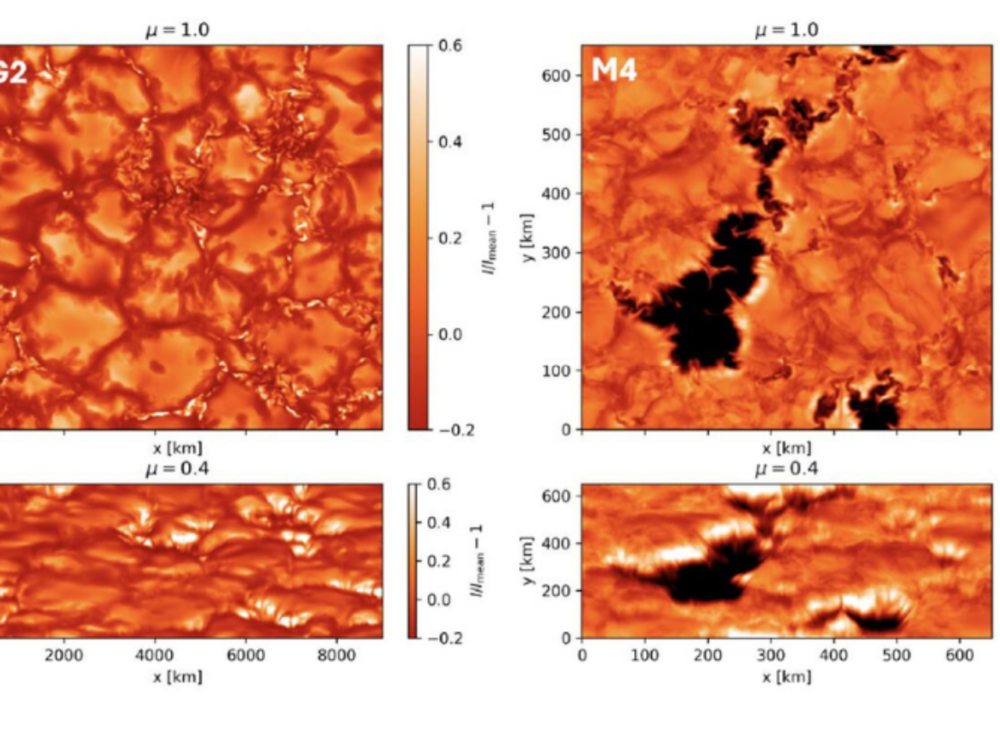
Simulated faculae on a Sun-like star (left) and a cool red dwarf star (right), shown at a wavelength of 600 nanometers.
Magnetic fields that make our Sun appear brighter can cause cool red dwarf stars to appear darker, as a new study demonstrates using detailed computer simulations.
Magnetic regions that enhance the brightness of the Sun can appear dark on cool red dwarf stars. Researchers at the University of Graz and their international collaborators have investigated this effect using advanced computer simulations. The study was selected by the editors of the American Astronomical Society (AAS) journals for a research highlight in AAS Nova, the Society’s research-highlights platform.
Faculae, small bright magnetic structures on the Sun, have so far not been directly observed on any other star. When interpreting the light emitted by other stars, astronomers have therefore generally assumed that magnetic regions behave in a manner similar to those on the Sun. The Graz-based research team has now put this assumption to the test.
Magnetic fields suppress convection, the process by which heat is transported toward a star’s surface. As a consequence, magnetic regions receive less thermal energy from deeper layers and therefore tend to become darker. At the same time, the magnetic field reduces the gas density within these regions, allowing radiation to emerge from deeper and hotter layers of the stellar atmosphere. On the Sun, this second effect dominates, causing faculae to appear bright.
On cool red dwarf stars, however, magnetic structures are shallower, while the temperature increases more gradually with depth. As a result, the associated brightening is insufficient to compensate for the reduced heat supply from the deeper layers, causing these magnetic structures to appear dark.
Cool red dwarf stars are the most abundant type of star in our Galaxy and are currently of particular interest in exoplanet research. Because these stars are relatively small, a planet passing in front of them blocks a comparatively large fraction of their light. This makes it possible for even the atmospheres of rocky planets to become accessible to observations with the James Webb Space Telescope.
Astronomers analyze the starlight transmitted through such a planetary atmosphere in order to identify the gases it contains. Magnetic regions on the stellar surface, however, also leave characteristic signatures in the observed light. If these stellar effects are not properly accounted for, they can mimic spectral features originating from the planetary atmosphere. Whether such magnetic regions appear bright or dark therefore directly influences the way in which the measured planetary signal may be distorted.
More information is available in the AAS Nova article:
When Bright Spots Go Dark
Publication:
A. I. Shapiro, S. Seager, S. K. Solanki et al.: The Curious Case of Dark Faculae on M Dwarf Stars. The Astrophysical Journal 1008, 24 (2026). doi.org/10.3847/1538-4357/ae7105
This research was supported by the ERC Synergy Grant REVEAL, coordinated by the University of Graz.